Wednesday, May 26, 2010

Happy Hour with Strawberries and A Cool Website about Alcohol

It can be fairly easy to bring a smile to my husband's face - he's just an upbeat person.  But the grin he had last night as he walked in the door and saw me mixing cocktails could have lit the house.  He's so cute.

If you recall, we try to have a happy hour at home at least once a week.  Last night I decided to mix up a cocktail with some of our plentiful strawberries.  Then I remembered the mint our friend Wendy brought us on  Sunday and I had a brainstorm.  Mojitos with strawberries, mint, and lemon...

Strawberry Mojito
Makes 1 tall glass

2 to 3 fresh stawberries - washed, stemmed, and chopped into bite-size pieces
2 to 3 fresh mint leaves
1 small wedge of lemon
2 tsp (or to taste) of simple syrup
2 oz (or to taste) of light rum
4 oz (or to taste) of lemon seltzer
crushed ice

Drop the strawberries, mint, and lemon wedge in the bottom of a glass.


Muddle or "smush" with a spoon to slightly crush the ingredients and release the juice of the fruit and essence of mint leaves and lemon peel. Add simple syrup and do more of the same to infuse those flavors into syrup.

Pour in rum and slightly stir.  Add crushed ice and mix gently with spoon.  Top with lemon seltzer and serve.  Mmmm...refreshing.


NOTES:  My husband makes a batch of simple syrup for us to keep in the fridge.  He steeped the last one with some mint leaves, and it worked well in this cocktail to provide an additional level of minty flavor.  You may want to use this technique or add a bit more mint leaves to your muddling mixture.

I also liked the extra layer of lemon from the seltzer.  You could elect to use plain seltzer or club soda.  The fizz is a nice touch, so stick with bubbly.

You could also switch to lime, if you prefer, but I thought the lemon would not compete so much with the strawberries.  Regardless, have fun mixing and experimenting.

Now, about that cool website...

How does that song go?
"When I'm not drinkin', I think about drinkin'.  When I'm not thinkin', I drink about you..."

If you are like me, you enjoy drinking, you enjoy reading, and you really enjoy reading about drinking.  So, if that is the case, I encourage you to visit a cool website known as AlcoholReviews.com.


The founder and editor, Kevin R. Kosar has a witty style and he shares lots of neat tidbits of interest to drinkers.  And, I'm proud to say he also generously gave me a shout out about our visit to Copper Fox Distillery earlier this month.  I encourage you to visit his site and keep thinkin' about drinkin'.

Tuesday, May 25, 2010

Strawberry Fields Forever

If you've been reading this blog for a while, you know that I've been anxiously awaiting the start of the warm weather growing season.   Fruit just tastes so much better when you pick it yourself or at least buy it from the farmer who recently picked it.

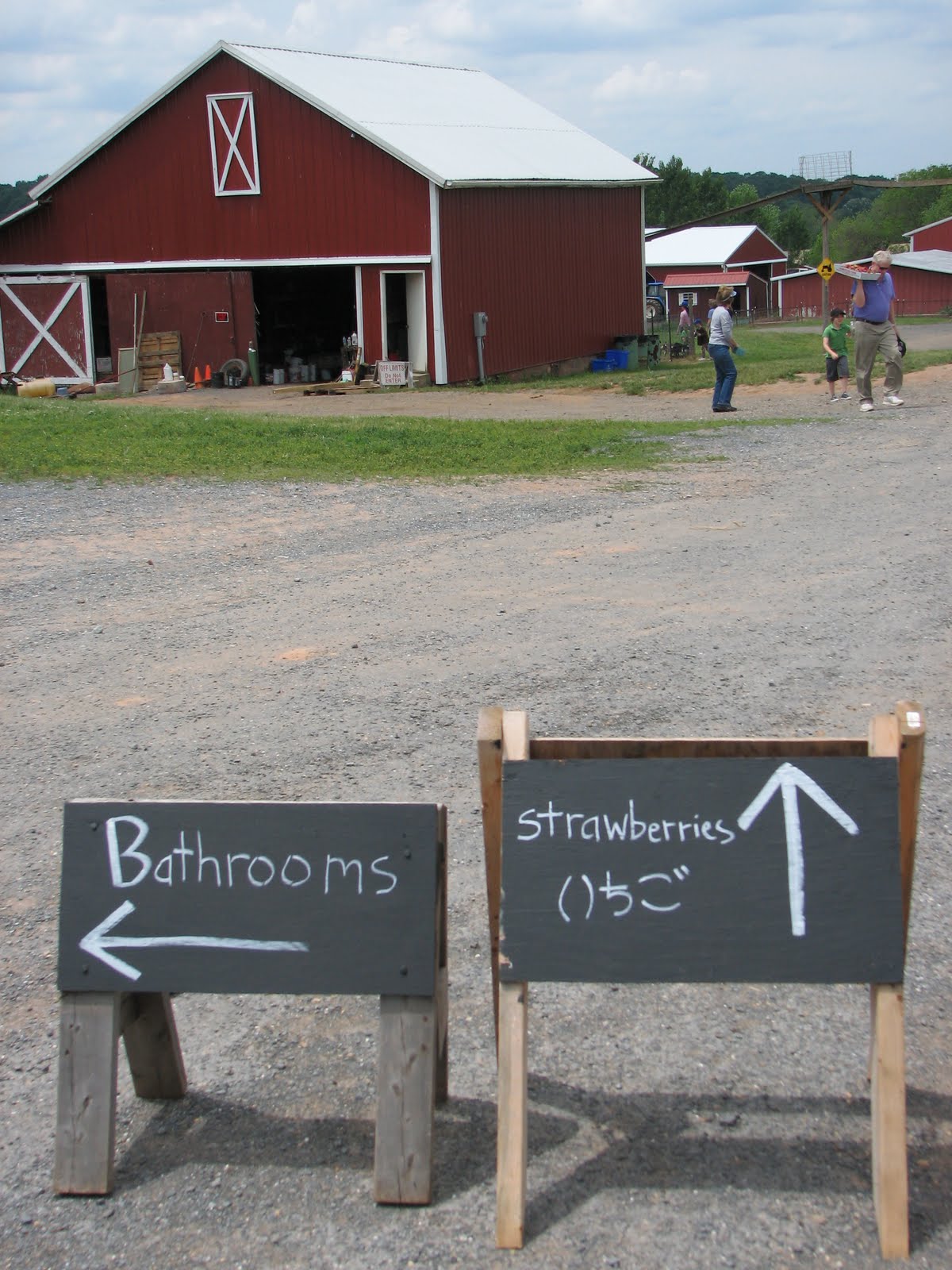
I made my first farm trip of the year this weekend when I picked strawberries with my friends Andrea and Christina.  We visited Homestead Farms in Poolesville, Maryland and I had a great time.


It has become a bit of tradition for us, and we have made the trip several times over recent years.  The farm is not far out of Washington, DC in Montgomery County, and has a variety of produce throughout the spring, summer, and fall.   We have a nice visit in the car, and then share ideas of how to use the fresh fruit.

It has become a pretty popular place with families, especially with an expanded petting area with goats and a calf, and a hayride to the picking fields.


Each season, we hear more languages spoken as immigrant families bring their kids to the farm, too.  This year we realized the farm is responding to this expanded clientele and we noticed a sign in what we think is Korean.  Neat,  huh?


The farm has a store to sell other kinds of produce and a kitchen that makes goodies with the fresh fruit.  Our favorite is the strawberry smoothie.  It wasn't quite as good this year.  I fear they may be responding to their clientele in another way by making the smoothie lighter in calories instead of rich in cream that coats your tongue with a slickness as you gulp down chunks of strawberries.  Sigh.  Don't worry I still drank it all, though.


I went a bit crazy this year in my picking....I came home with over 10 pounds of strawberries.


It was a gorgeous day and the berries were plentiful, so it was easy to get carried away.  The smell of freshly picked strawberries is just heavenly, and it made the car ride home even more cheery.


I have big plans for them, so I'm not worried about using them all.  In fact, you should expect to read multiple entries about strawberries in the coming days.  I hope Andrea will share her recipe for strawberry bread so I can try it out.

Our first treat, though, was strawberry cream popsicles.  I thought they would make a nice dessert after our heavy meal of beef brisket.  Plus, we could use the new popsicle molds my husband and I got from my parents for Christmas.  It was my first time to make popsicles from fresh fruit, and I imagine I will continue to tinker with the recipe, but here is what I did this time.

Homemade Strawberry Cream Popsicles
Made 6 popsicles, using Tovolo brand molds

2 1/2 cups of stemmed and chopped fresh strawberries
1/3 cup sugar
1/2 cup milk
1/2 cup plain yogurt


Mix all ingredients in a blender or food processor until fruit is pureed and all is well blended.  A blender is best, but I had to use our food processor since our neighbor borrowed our blender late one night for some boozy margarita fun.  The processor will work in a pinch.  Pour the blended mixture into molds, insert sticks, and place in freezer until firm.  You should allow at least 8 hours.

This is really easy, so I encourage you to experiment with the process and different fruits.  You can adjust the sugar to your taste and use all milk, instead of a combination with yogurt to equally delicious results.

A note on the lack of preciseness: I don't have a kitchen scale yet, so I couldn't weigh the strawberries.  Because of that, this recipe is not exact.  I mean, we each cut our strawberries slightly differently and they contain different amounts of liquid so just consider this a rough proportion.


In case you were wondering, here are the popsicle molds we used...


Monday, May 24, 2010

Suitcase Meat

On our trip to Texas in April, my husband and I decided to bring back some of the foodstuffs that we can't get here in DC.  The most important item for us was barbeque beef brisket.  Not only can we not get large beef briskets at good prices, but we also don't have a smoker.  We had a craving as we had not had good barbeque since our wedding in October, and our friends were clamoring for us to bring some barbeque back.

So, on the first day of our trip, we purchased a 12 pound beef brisket at HEB.  My dad seasoned it and smoked it for several hours over mesquite wood.


Then, we wrapped the cooked brisket carefully and placed it in the freezer it for the remainder of our trip.  The next step was insuring safe passage and TSA allowance.  After several hours of research and a call to the airline, we decided that we would wrap the brisket in plastic, pad it with styrofoam, and pack it in a hard-sided suitcase.  With a trip to Goodwill, we scored a large American Tourister suitcase for 9 bucks.

We made sure it was frozen solid before packing and well insulated and padded for travel.  I was a nervous wreck for the entire trip home.  We decided to check the hard-sided meat suitcase.  I was sure that TSA was going to have a problem with this large mass of aluminum foil and plastic wrap, and our brisket was going to be confiscated.  We didn't get called back from the gate, so once we boarded the plane I focused my anxiety on the thoughts that the meat suitcase wasn't going to make the connecting flight and our plans for a barbeque feast would be crushed.

Well, I'm thrilled to report that the brisket made it safe and sound.  With all the insulation, it stayed frozen through our extended trip to our great relief.  We popped it in our freezer and began planning the special feast in which we would share the brisket with our friends.

We hosted a small dinner for a few friends this weekend to serve the special suitcase meat.  I'd never frozen barbeque before, so I wasn't quite sure how to reheat it.  We knew we would use the oven to warm it, but we wanted to be careful not to dry out the meat.  It was fully cooked, we just wanted it warm for serving.  After a bit of debate, we landed on a strategy.


We defrosted the large brisket for two days in the refrigerator.  About two hours before we wanted to eat, we unwrapped the brisket and put in a roasting pan.


It smelled absolutely wonderful with spice and mesquite smoke, and I had dogs pacing at my feet as I unwrapped it.  I combined two cups of beef broth with some of the secret spices I would have put on a brisket to barbeque, and poured it over the meat and let it pool in the bottom of the roasting pan.


Then, I covered it with foil, making sure that it was tightly covering the ends so that they would not dry out too much.  I put it in a 225 degree F oven for almost two hours.  When it was warm enough for us, my husband carved the meat and my brother started grabbing before I could take a picture.  They didn't give me a chance to take a composed picture, but I think it looks darn good.  And, it was very tasty. 

Mmmmm.....

Friday, May 21, 2010

Smoke Gets In Your Eyes

Our tour of the whiskey distillery got me thinking about wood.  No, not that kind of wood.  I mean, how wood instead of peat can be burned so smoke flavors the malt and wood chips are used to age and flavor the spirits.  It reminded me of the importance of smoke in barbeque. 

Even though barbeque meat is seasoned with spice rubs, basted or mopped with liquids, and plunged in sauce, its dominant flavor is smoke.  Depending on the wood burned, the smoke can be sweet or acrid, fruity or resinous.  The word barbeque even comes from the Spanish word barbacoa, which means a grid of green (fire resistant) sticks on which food is placed high above a fire to smoke.

Hardwoods have sugar molecules that produce aromas and proteins which contribute to roasted flavors.  Most softwoods, like pines and firs, have significant quantities of resin that produce a harsh tasting soot when burned.  This is not preferential for smoking food.  So, don't use your Christmas tree in the barbeque pit.  Since different species of trees have different amounts of these sugars and proteins, they impart different flavors to food.  The temperature at which wood burns can also impact cooking with smoke.  The ideal is low, smoldering temperatures for wood in your barbeque cooker.  Because some hardwoods burn so hot, pitmasters sometimes choose to lower the combustion temperature by soaking wood chunks in water before placing them on a fire.

Some common woods used in smoking are:
  • Alder – light, aromatic smoke; preferred for salmon
  • Apple and Cherry – sweet, fruity smoke; great with poultry and pork
  • Hickory – strong, full-flavored smoke; popular with ribs, pork shoulder, bacon, and turkey
  • Maple – sweet and fragrant smoke; goes well with chicken and full-flavored fish
  • Mesquite – heavy smoke with a pungent flavor; works best with beef and sausage
  • Oak – good all-purpose smoky flavor, not as strong as hickory or mesquite and never bitter
  • Pecan – rich, fragrant, mellow smoke; won’t overpower delicate seafood
 Mesquite is my favorite wood for barbeque and it imparts a very strong flavor to meat.  Because of that, it works best with meats that have an equally strong flavor, like beef or wild game, but I like it with everything.  I find it bit sweet and very aromatic.  It is also the most common wood used in Texas barbeque. 

My dad uses mesquite in his cooking.  When my brother and I were kids, we regularly helped him scrounge pieces from nearby ranches before our barbeques because the trees are considered a nuisance.  Ranchers aren’t too fond of mesquite trees because they compete with grass for moisture, and cattle need grass.  Right now, my dad has a plentiful supply since Hurricane Dolly knocked out several mesquite trees and he was able to chop them up and stash them my his barbeque cooker.

Thursday, May 20, 2010

Grilling is Not Barbeque

In case you can’t tell I’m a huge fan of Texas barbeque.  I’ve decided it is both a science and an art.  I figure if I can better understand the science behind good tasting meat, I can begin to cultivate the art of great tasting barbeque.

Real Texas barbeque can’t happen on a gas grill.  Grilling is fast cooking over high heat, while barbequing is slow cooking over low heat.  Typically, gas grills cannot maintain a low enough temperature for proper slow cooked barbeque. 

Smoke is the key.  

A gas grill cannot match the flavor imparted to food from wood or charcoal smoke.  During grilling, the meat is exposed to air, but during barbequing or smoking the BBQ lid or smoker door is closed, enveloping the meat in a thick cloud of smoke.   Mmmm...can't you just smell it?  Many barbeque pits have a system of vents that can be opened or closed to control the amount of heat and smoke that contact the food.  The smoke must be able to move freely around the meat and out of the top of the smoker/cooker/pit quickly so that creosote will not build up on the meat and give it a bitter flavor.  Sometimes a pan of water in also placed in the cooking chamber to provide steam.


Smoked meats such as Texas barbeque usually still have a red tinge to them, even when completely cooked and will have what is known as a smoke ring - a thin pink layer around the edges.  This coloring of the meat is caused by a reaction between the carbon monoxide of the smoke binding with the iron in the myoglobin of the meat.  How about that word, huh?  Myoglobin, in case you were wondering, is the oxygen-binding protein in muscle.

Tender cuts of meat are best for grilling, but they require close attention. Vegetables and fruits can also be grilled because they don't need a long cooking time either.  The quick cooking and the high heat work to seal in the juices, but if you leave the meat on too long it can dry out.  This can happen with any dry cooking method, however, it is best not to walk away from your grill. Sauces can be used, but with such high heat, it is better when added near the end of the cooking time, so they won’t burn.

Tougher cuts of meats, such as beef brisket (my favorite) or pork ribs, are usually used in barbeque. These meats benefit from the long, slow cooking process that softens the thick connective tissue surrounding the muscle fibers.   The meat can become so tender it can fall off the bone. Since the heat is not as high as grilling, barbeque sauce can be brushed onto the meat throughout the cooking process, if desired.

This is the first of several installments about Texas barbeque.  Stay tuned for an entry on wood smoke – the flavor of barbeque.